"...it is not true that when the heart is full the eyes necessarily overflow, some people can never manage it, especially in our century, which in spite of all the suffering and sorrow will surely be known to posterity as the tearless century. It was this drought, this tearlessness that brought those who could afford it to Schmuh's Onion Cellar, where the host handed them a little cutting board - pig or fish - a paring knife for eighty pfennigs, and for twelve marks an ordinary, field-, garden-, and kitchen-variety onion, and induced them to cut their onions smaller and smaller until the juice - what did the onion juice do? It did what the world and the sorrows of the world could not do: it brought forth a round, human tear. It made them cry."

Günter Grass: Die Blechtrommel

Monday, August 19, 2013

Charting Uncharted Territory


While scrolling through some photos I’d taken in Newfoundland I ran across a photo of the infamous Captain James Cook taken at a lighthouse in the Gros Morne National Park. Coincidentally, just a few weeks earlier this summer, I found myself face to face with the Captain again in a museum in Sydney, Australia.  
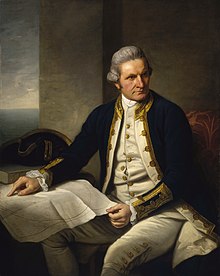
Captainjamescookportrait.jpg

The Captain really got around. I had forgotten about the lighthouse portrait in Newfoundland until I ran across the photo.  Cook, a man of Yorkshire, England, began his career with an apprenticeship in the Merchant Marines and eventually climbed to the level of Captain of the Royal Navy by the time he was killed on the Hawaiian Islands. On voyages that circumnavigated the globe, Cook mapped a good deal of the unknown world of his day. His greatest contributions include surveying and mapping the coastline of Newfoundland in the 1760s, and ten years later discovering and assessing the size and extent of Australia and New Zealand.


In telling my traveling companion that I’d run across the photo of Captain James Cook taken in Newfoundland, he asked, “from Star Trek?”, referring to Captain James Kirk - which actually is somewhat apropos, because William Shatner is Canadian. I laughed and thought it was an amusing play on the name. 
  

But as I am a fairly serious Trekkie, I then did a little research on Captain James Kirk and discovered that Gene Roddenberry actually used Captain James Cook as his model for Captain James Tiberius Kirk – it was no coincidence after all. Captain Cook apparently wrote in his journal entry, “ambition leads me ... farther than any other man has been before me." Roddenberry was inspired by Cook’s exploits and reformulated the statement, to create the Kirk’s iconic soliloquy at the opening of the Star Trek credits:

Space: The final frontier
These are the voyages of the Starship, Enterprise
Its five year mission
To explore strange new worlds
To seek out new life and new civilizations
To boldly go where no man has gone before

If you drop the first line and make a couple of minor adjustments to the statement -such as...

Southern hemisphere: The final frontier
These are the voyages of the HMS, Endeavor (or Resolution)
Its three year mission
To explore strange new worlds
To seek out new life and new civilizations
To boldly go where no Englishman has gone before

...this pretty well describes Cook and his actual historic accomplishments. Although my little travels aren’t on the scale of Cooks, it occurs to me that I am mapping our little planet in my own way, if not mapping it literally for civilization or the Crown. 

When traveling I prefer to go on foot as much as possible and I remember every path I’ve hiked and alley I’ve walked (with the help of my photos). I’m slowly filling in the vast uncharted territories of my mind with memories and impressions of the places that were formerly just a name from my geography lessons and the occasional reference in a book.  The beauty of a mental map is that the details of each voyage expand the map exponentially - in many dimensions – I was thinking of this as I walked a short distance down a path that Charles Darwin took through the Blue Mountains of Australia.


Sixty-five years after Cook arrived in Australia, Darwin arrived on the east coast of Australia aboard the HMS Beagle to gather samples of the flora and fauna of the newly discovered continent. What must Darwin have thought as he encountered a land where mammals’ young mature in pockets outside their bodies, where the colors of corals along the coastline rival the most ornate English gardens but ravage any ship that approaches, where conifers and other exotic flora that grew alongside the dinosaurs still flourish, and where time seemed to have stood still for the hunter gatherer groups that populated the continent?


This was a time when English exploration was still all the rage, but when the power of the Crown had diminished substantially in the southern hemisphere. Like Cook, Darwin spent years of his life circumnavigating the globe, but Darwin was on a voyage to find the connections and patterns in life that would form his subsequent theory of natural selection. While he was not literally charting the islands, he was mapping the biodiversity of the planet with each new specimen.

It is amusing that there is an Australian city named for Darwin, yet Darwin never actually visited this part of Australia. Upon the discovery of the harbor by the English, it was named in tribute to Charles Darwin by his former shipmate and fellow naturalist - Lieutenant John Lort Stokes - during the HMS Beagle's third voyage in 1839. The official name of the city was not changed to Darwin until 1911. Darwin only sailed into Botany Bay, in what is now Sydney and then traveled inland along the riverbeds into the Blue Mountains.

 
As apt as the name Botany Bay seems to be, it was actually discovered and named by Cook for its amazing quantity and diversity of plant life.  This is likely what drew Darwin to the harbor in the first place.   

It is easy to retrospectively take much of Darwin’s theory for granted because it is now so entrenched in our understanding of evolution, but upon his arrival in Australia Darwin was grappling with how and why a creator would have experimented with such variety in different parts of the world and gradually became convinced some biological mechanism was at work that operated independently of a god. It took experiencing the richness of the earth’s biodiversity - and a lot of courage - to conceive of a perpetually changing planet;  to move beyond thinking in terms of the ‘exotic’ versus the ‘ordinary’ and toward identifying patterns of similarity at the root of all life. Darwin was not privy to our current understanding of plate tectonics; he was from a world of creationist views that held the earth to be a fixed and static globe. Yet he surmised that life was connected at its roots, even across the hemispheres and across oceans separating isolated island continents such as Australia from their nearest neighboring land masses. Darwin was making mental maps that wove information together dimensionally on geographic, botanical, anthropological and philosophical planes. This is the dimensional beauty of mental maps.

Did Darwin travel to fill his own uncharted inner territory? Do we all travel to map the landscape of our minds?  Or do we fill in our uncharted territory simply because we travel?

Man has a history of wanderlust - some of us inheriting a bigger dose of it than others. We feel an innate need to travel, as if our existence depends on it; we yearn to explore the world in the same way others might yearn for a shiny new car or pair of boots. I’m not sure that it’s essential to identify why man travels, but what seems more important and compelling is that travel motivates man – it works the mind – stimulating, relaxing, and expanding its boundaries. When traveling the usual biases, boundaries, routines, and surroundings are replaced with the ‘new,’ the ‘unusual’ and the ‘boundless’. Travel also seems to be what we adults might label ‘play time.’  There is a sense of childlike freedom associated with travel that opens our minds. We experience raptures of joy, curiosity and awe while playing in our new environments. We pause, observe, we puzzle over what we’ve seen, we learn, and we actually occasionally change. Even the oldest dogs among us learn new tricks! Our mind’s map expands, our spectrum of knowledge is stretched and deepened. On occasion we even make connections across the vast landscape of our mind that open up whole new vistas and dimensions of thought. And isn’t this essentially what Darwin experienced on the HMS Beagle so long ago? And on a much more mundane level, isn’t this what I did with Captain Cook and Captain Kirk?

But I found many other parallels with parts of the planet in my travels across Australia. Being from the western desert country of the U.S.A., I felt very at home in the red cliffs of Litchfield National Park and the Blue Mountains, and for me, the red monoliths of Uluru and Kata Tjuta exude the same drama as red rock cliffs found in Zions National Park or Snow Canyon.


While the yellow soil of Australia is the stage for the Pinacles near Perth, the landscape is not unlike Goblin Valley in southern Utah – only Goblin Valley is painted in red tones rather than in yellows.


The Great Ocean Road is a coastal stretch of highway that rivals Route 101 through California and Oregon - running from Melbourne up the coast to Adelaide - with its stunning cliffs, churning seas and luscious beaches.


The Barossa Valley has a charm and history that echoes Napa Valley or Sonoma County.


While each place is unique, one begins to understand that there is red or yellow soil in many lands, that the sea carves remarkable coastal vistas on many continents, and that man has sculpted the lush landscapes of many beautiful valleys all over the world into wine producing Meccas.    

One of the icons of western tradition is Ulysses and his Odyssey – or perhaps both of them. Both sailed into the unknown and found new worlds – one of mythic proportions, one of a more mundane experiential nature. But still, both voyaged deeper into themselves in the process, which leads to whether it is necessary to physically travel to another land to experience the new and be changed by it. Joyce makes clear that each day is a new voyage of sorts for his protagonist. But in our familiar milieu it is much harder to change when we close our eyes to the same wallpaper each night, eat the same two slices of toast each morning, and passively await the rare disruption of our routine. Routine generally makes us ‘check out’ mentally - that’s the intention really, to take action that we want or need to take with the minimum level of effort or thought. We perfect the fine art of living on rote, and become a bit numb to the world we pass by each day. It usually takes something new or different to grab our attention, and jar us into taking notice. Since travel usually involves a change of routine and often in novel settings, this novelty invites our attention and stimulates like nothing else can.

When traveling, my attention is first outward toward the new sensory input I’m experiencing. But as I contemplate the new stimuli, I start to see connections - to absorb the new and make it my own. The world becomes both bigger and smaller – bigger in scope, depth and variety, yet smaller in the root similarities of life and landscape that bind things into unities on a global plane. The vast uncharted territory of my mind is formed through memories of my voyage through life - memories that shape my actions and expand my understanding of this odyssey we call existence.

Sunday, April 3, 2011

El Toro

I should have guessed that the famous Knossos fresco of a vault over the back of a bull was part of the lineage of contemporary Spanish bullfighting when we saw it in Crete.


But at the time it did not occur to me.  What seemed closer to its root was the ancient Summarian tale of Gilgamesh and Enkidu’s epic fight with the Bull of Heaven (this being the oldest known tale in recorded history).  In The Epic of Gilgamesh, Ishtar–the goddess of Fertility–states: “My father, give me the Bull of Heaven to destroy Gilgamesh.  Fill Gilgamesh, I say, with arrogance to his destruction; but if you refuse to give me the Bull of Heaven I will break in the doors of hell and smash the bolts; there will be confusion of the people, those above with those from the lower depths.  I shall bring up the dead to eat food like the living; and the hosts of dead will outnumber the living.”
The tale continues:
    When Anu heard what Ishtar had said he gave her the Bull of Heaven to lead by the halter down to Uruk. When they reached the gates of Uruk the Bull went to the river; with his first snort cracks opened in the earth and a hundred young men fell down to death.  With his second snort cracks opened and two hundred fell down to death.  With his third snort cracks opened, Enkidu doubled over by instantly recovered, he dodged aside and leapt on the Bull and seized it by the horns.  The Bull of Heaven foamed in his face, it brushed him with the thick its tail.  Enkidu cried to Gilgamesh, ‘My friend, we boasted that we would leave enduring names behind us.  Now thrust in your sword between the nape of the horns.’ So Gilgamesh followed the Bull, he seized the thick of its tail, he thrust the sword between the nape and the horns and slew the Bull.

These ancient tales of ritual bullfighting are all linked and appear in various forms throughout the subsequent ancient civilizations–the Persians had their version, the Greeks had another version, the Minoans had theirs.  The ritual killing of the sacred bull–or “tauromachia” found its way into the traditions of the Iberian peninsula through the exploits of the pagan god, Mithras, expressed in the Roman Mithraic Mysteries.


An exclusively male cult of Mithras was apparently popular with the Roman military and seemed to serve much the same function as the killing of the Bull of Heaven in The Epic of Gilgamesh–a ritual path through which man gained fame and respect–a  symbolic conquering of the power of the heavens through a series of trials.  Another vestige of this legend is the astrological bull in our contemporary zodiac.  Taurus, the symbol for the period spanning roughly from April 21st through May 21st, reflects the ancients' representations of the power of the sacred Bull of Heaven– a power that was ripe for the taking.

Bullfighting is still practiced in parts of Spain and France.  In Arles, for example, we saw that the old Roman amphitheater was booked for an upcoming bullfight.  This marries the current tradition of bullfighting with the pagan Roman Mithraic cult practices–they often fight in the same arenas in which the ritual bullfights were practiced in the 1st through the 4th centuries A.D.


Being rather ideologically opposed to ritual slaughters, however, I have avoided the bull ring on principle.  So when we wandered into Seville last summer, attending a bullfight was not on our agenda.  But one thing that was on the agenda was a day trip to the Roman ruins of Italica on the outskirts of the city.

Italica is one of the best preserved Roman sites in Spain and overlooks the small city of Santiponce near Seville.  We headed out to Santiponce early on the local bus which took some time but delivered us almost to the entry gate of the ruins.  The remnants of the old Roman city are not as well preserved as the amphitheater, but the view of the sweeping countryside from the city in its day must have been quite impressive.


Most of what remains are mosaic floors and bits of columns that line the city streets.  The site still seems to be in the process of excavation, so perhaps more of the city will emerge over time.  Except for the poplars lining the roads, the landscape is dry and barren.  But nearer to the amphitheater is a small lake at the bottom of the hill, where there are flowers and shrubs and an army of cicadas filling the air with their mating call.


The amphitheater itself is mostly intact and has an extensive series of access and drainage tunnels that surround the central arena.


One can imagine walking into the massive circle with cheers for the fighters filling the air.

With only myself and the cicadas in the rubble of the tiered stone benches to witness and applaud him, my companion stepped bravely into the arena.


There he invoked Anu, Zeus, Jupiter or any other of the remaining gods of the heavens who still answered the call of man to send the sacred bull to the ring so that he could win fame and glory. 


And with only a humble bandanna he too taunted, mesmerized and vanquished the Bull of Heaven to the cheers and chirps of the entranced spectators–ensuring that his name, like Gilgamesh, Mithras and all other legendary matadors, would be passed down through the ages and remembered by all.


Sunday, March 20, 2011

World Cup 2010

Humans are territorial, sadly, so we wage war on each other to stake out our turf.  But we also channel some of this aggression into other less deadly pastimes–like football.  People love football, almost as much as they love war (and in this case I am not talking “American football,” I am talking about football as practiced in the rest of the world).  Football provides a venue for territorial rivalry that actually adds a little cohesion to society, while it pumps up the adrenalin and lets boys be boys.

Last summer the World Cup was following us around Europe.  Being avid sports enthusiasts, we were only first aware of the World Cup games as we were nearing our departure from Portugal.  We were in Mértola at the Clube Nautico the night that Spain and Portugal were facing off–the winner heading for the quarter-finals.  There was a long table set up in the center of the small family owned club that was obviously specially prepared for the game.  The restaurant was still lively when we arrived, although the game was over and Portugal had lost.  But for the Portuguese, the fact that Spain was still in the running was a good second best, since Spain has been part of the Iberian psyche for many centuries.  The party went on, even in defeat.

The game played for the quarter-finals between Paraguay and Spain occurred while we were in Seville.  That evening, after sampling  a number of tapas bars in the old section of Seville, we returned to the first one we had eaten at near Alfalfa square–it was already our favorite.  As we sipped our wine and the delicacies began to flow, cheers erupted from the bar where the waiters were following the game.


By the time we reached Barcelona, the World Cup was into the semi-finals and spirits were running high.  Before our dinner, we saw crowds of people gathered round the big-screen TVs at the bars along the streets–drinking beer and almost frozen in anticipation of the outcome.  Spain hadn’t been in the finals for many years and they were so very very close that they could almost taste it.  The fervor was palpable if temporarily held in check.  At about 22:00, while chasing our dinner wine with an espresso, all hell broke loose. 


Spaniards on the upper balconies overlooking the streets were pouring water down onto passers-by and a very inebriated crowd was gathering in the old Medieval sector that began chanting their victory “whoop.”  We hung back at first, wondering how frenzied it would become–not wanting to be killed in a post-game riot.  But of course, this was not South Africa, it was Barcelona, and there was no rival in sight.  The Spaniards just wanted to party hard in celebration.


We forged our way down into the melee and chanted with the best of them.  It was mob hysteria, but not quite bordering on out-of-control.  The police were clearly worried–while they were smiling and enjoying themselves on one hand, they were keeping a sharp eye out for trouble on the other.  I think the chanting continued for at least 45 minutes.  We grew tired of it after about 25 minutes and wandered up the street toward our hotel.  But we could hear the celebrations from our room until late into the night.

Oddly enough, we were scheduled to fly into Amsterdam on July 11th, the day of the finals between the Netherlands and Spain.  Spirits were rolling even higher in Amsterdam ahead of the game.  It looked to have been a long party day by the debris we encountered along the streets on the way to our flat.


As we walked through the city a little later, an elderly man became rather angry at us for taking photos of all the party residue.  He assured us that Amsterdam was a beautiful city and didn't want us to be documenting the mess.  We told him that we understood this was the kind of liter one would find anywhere in the world following a World Cup final and that we were only photographing it because we found it interesting in a social sense.

On the way to dinner, we saw most of the population of Amsterdam glued in silent angst to TVs everywhere along the streets.


When we returned to the flat we switched on the TV and watched the end of the game.  As near as I can gauge–being in no way well informed on the subject–the Netherlands goalkeeper was amazing and nearly saved the eventual loss, but the Spaniards simply played much more offensively and the Netherlanders were playing it a little too safe–defending more than attacking–so it was only a matter of time.  Consequently, we were there to feel the sting of the Netherlands’ defeat.


But on the upside (as a resident of Amsterdam pointed out), the Netherlands hadn’t played a game as high profile as this in 22 years–since they took the 1988 European Football Championship–so in spite of their disappointment, Amsterdam was still in party mode for the team homecoming.  It was a great showing for the Netherlands–even if they were second to Spain.  They could claim their place as the 2nd best team in the world for 2010, and that is no small accomplishment.

People gathered along the canals for the official parade over half a day before it was to happen–everyone wanting to score a good view of the boats that would be passing by.  The city was again a flood of orange and spirits were off the charts; people hung out of windows, climbed lampposts, stripped naked and jumped into the canals as they killed time waiting for the show.


Then as the team passed there was a sea of orange and a din of cheers from the time the team came into view until they rounded the corner of the canal and wove out of our sight.


It was infective and the party atmosphere didn’t abate until the wee hours of the morning.

We couldn’t have planned our trip to coincide better with the football finals if we had tried, even though we had only a passing interest in them.  And although we were actually in the losing country when they were defeated, we really felt it was probably better, since judging by the semi-final win in Spain, the final was probably quite out-of-control.  The Netherlands were stalwart and gracious in their defeat despite their disappointment.  But in any case, I didn’t want to take sides–I was rooting for them both to some extent.  I had loved my time visiting both lands and the people were friendly and warm in both–from a human standpoint, both deserved to win.